Knossos Palace Opening Hours and the Best Time to Visit
Knossos changes its closing time six times between April and November. Here are the 2026 hours, last admission, free-entry days, and the hour to arrive.
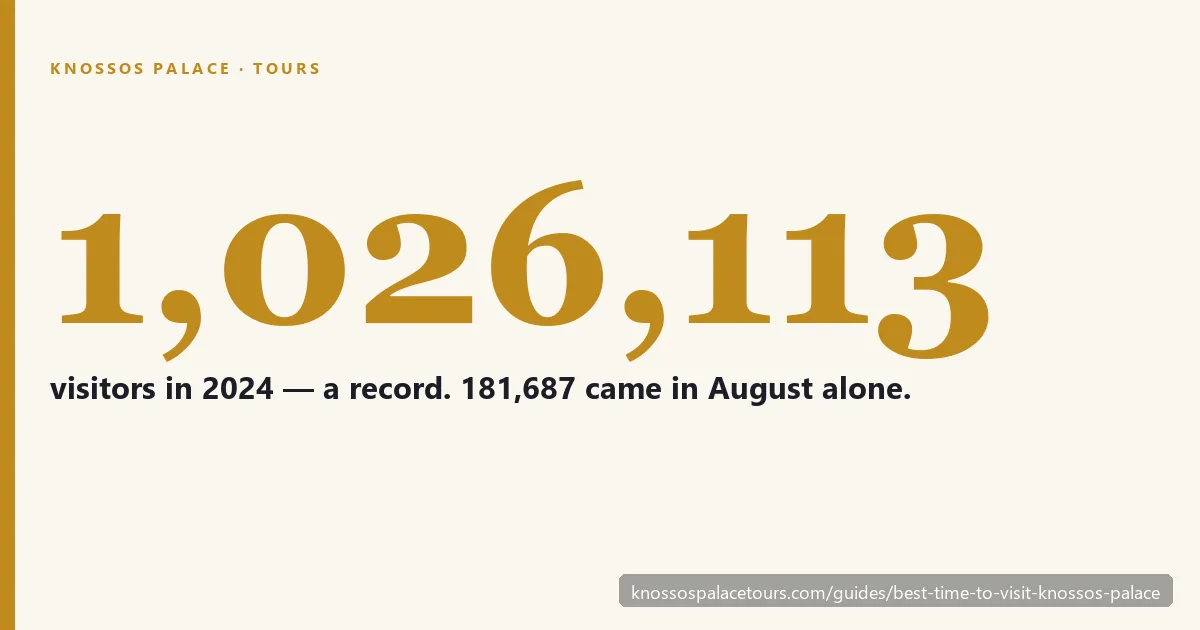
Knossos is open daily for most of the year, but its closing time changes six times between April and November — and almost nobody checks. A visitor arriving at 18:30 in August has two hours left inside the palace. The same arrival on 20 September is half an hour too late to be admitted at all. Layered on top of that is the crowd: Knossos passed a million visitors in 2024 — 1,026,113 of them, a record year, making it the second most visited archaeological attraction in Greece after the Acropolis. August alone brought 181,687 people, which works out at well over 5,000 on a busy day, funnelled through one entrance onto a site with almost no shade. The month you choose matters. The hour you choose matters more.
Check Availability
Quick answer: If you can pick any slot, enter at 08:00 or roughly two hours before the day’s actual closing time. In July and August, early morning is the safer of the two.
Knossos Palace opening hours in 2026
Knossos does not keep one schedule through the summer. It steps down in stages from the start of September, and the steps are close enough together that a timetable copied from a blog in July is wrong by the end of the month.
| Dates | Opening hours | Last admission |
|---|---|---|
| 1 April – 31 August | 08:00–20:00 | 19:40 |
| 1–15 September | 08:00–19:30 | 19:10 |
| 16–30 September | 08:00–19:00 | 18:40 |
| 1–15 October | 08:00–18:30 | 18:10 |
| 16–31 October | 08:00–18:00 | 17:40 |
| 1 November – 31 March | 08:00–17:00 | 16:40 |
The official visitor information puts last admission 20 minutes before closing, every season. Opening times can also change at short notice for exceptional weather, staffing or operational reasons, so check the official Hellenic Heritage e-ticket system again shortly before you travel rather than trusting this table — or any table — on the day.
Is Knossos Palace open every day?
Yes, in normal operation, weekends included. The site is closed on a short list of public holidays:
- 1 January
- 25 March
- 1 May
- Easter Sunday
- 25 December
- 26 December
Greek Orthodox Easter moves each year and rarely falls on the same weekend as Western Easter, so if you are travelling in spring, look up the date rather than assuming. Holiday schedules are occasionally revised, so confirm your exact date before you commit to it.
What is the best time of day to visit Knossos?
There are three realistic slots, and they are not equally good.
1. At opening time: best overall
Arriving for 08:00 is the safest all-round choice, and from late spring through early autumn it is not close. You get cooler air, the least time standing in direct sun, the freedom to stay longer if the site pulls you in, and an easy run into the Heraklion Archaeological Museum afterwards. If Knossos is one of the reasons you came to Crete, this is the slot to take.
There is a second, less obvious reason. The real pinch point is 10:00 to 11:00, when the coaches from Heraklion’s cruise port and the organised day trips from Rethymno, Chania and the resorts all converge on the same car park inside an hour of each other. Arriving before that puts you inside the palace while it is quiet; arriving during it means queuing to enter, then queuing again at every narrow point on the route.
In July and August an early start earns its keep twice over, because the temperature is uncomfortable well before noon.
2. Late afternoon: best alternative in summer
If an early start is not going to happen, the last couple of hours before closing work well. The light softens, the stone stops radiating, and the site empties as the coaches leave.
The catch is that you must work backwards from the actual seasonal closing time, not from the 20:00 you remember from August:
- in August, a 17:30–18:00 arrival still leaves you plenty of time
- in early September, closing moves to 19:30
- after 16 September, it moves again to 19:00
- through October, an evening visit stops being practical at all
Do not assume Knossos stays open until 20:00 for the whole tourist season. It does not.
3. Midday: workable, but usually the least comfortable
A midday visit is perfectly possible and, outside high summer, perfectly pleasant. In hot weather it is the weakest of the three. Knossos is an open archaeological site with long exposed stretches, and the combination of strong sun, bare stone and a slow walking pace is more tiring than most visitors expect.
If midday is the only window your itinerary allows, bring water, wear a hat, use sunscreen, put on comfortable shoes, take breaks instead of pushing through, and check for heat-related visitor notices before you leave. In periods of exceptional heat, Greek archaeological sites can temporarily alter their hours, and Knossos itself has closed over the middle of the day during heat events. That is not a theoretical risk.
Best time to visit Knossos by season
The best month depends on whether you are optimising for weather, for long opening hours, for sightseeing comfort, or for a Crete holiday that happens to include a palace.
April
April is one of the most comfortable months of the year for sightseeing here. The long summer schedule starts on 1 April, so you get the full 08:00–20:00 window without any of the midsummer heat, and the landscape around the site is still green from the winter rains.
The trade-off is predictability: April weather is less settled than June’s, and the sea is still cool if your trip also involves beaches. For a primarily cultural trip, it is an excellent choice.
May
May combines long daylight, warm but not punishing weather and full summer opening hours. Highs sit in the low-to-mid twenties Celsius, rain is negligible, and the crowd is a fraction of the August one. For most travellers this is the best single month of the year, and the 20:00 closing gives you room to go early or late as the day works out.
June
June is still very good, but heat starts to matter. An 08:00 visit becomes increasingly attractive: palace in the morning, lunch in Heraklion, museum in the afternoon. By this point avoiding the middle of the day is about comfort rather than opening hours — you still have until 20:00.
July
July has the longest schedule and some of the most demanding conditions. The site is open 08:00–20:00, and the middle of that window can be genuinely hard work. Heraklion averages around 25°C in July with highs near 30°C, and it essentially never rains.
The strategy is simple: Knossos at 08:00, out before midday, indoor or shaded activities afterwards. If an early visit is impossible, take late afternoon instead. July was also the second busiest month of 2024 at 165,168 visitors.
August
August is July with more people — 181,687 visitors in 2024, the busiest month on record at the site. Long hours, strong sun, high temperatures. An 08:00 entry remains the safest choice and late afternoon the second best. Because extreme heat can trigger temporary changes at archaeological sites, check current notices before setting out.
September
September can be excellent, and it is the month where the changing schedule catches people out:
- 1–15 September: 08:00–19:30
- 16–30 September: 08:00–19:00
Temperatures ease as the month goes on while Crete still feels like a summer destination. The crowd thins too, though 147,039 people came in September 2024, so “thinner” is relative. Late September is one of the best compromises between weather and sightseeing conditions on the calendar.
October
October is a very good month if archaeology is the point of the trip. The schedule shortens again:
- 1–15 October: 08:00–18:30
- 16–31 October: 08:00–18:00
You lose the long evenings, but daytime temperatures are far kinder for walking around exposed ruins, and visitor numbers drop to 124,316 for the month. Rain begins to return but is rarely disruptive. Visit earlier in the day rather than counting on an evening slot.
November to March
From 1 November to 31 March the site runs 08:00–17:00 and the experience changes character entirely: cool walking conditions, a quiet site, and midday perfectly comfortable. Against that, the day is short, the weather is less predictable, daylight is limited, and much of Crete’s tourism infrastructure elsewhere is shut. If you care about the archaeology and not about beach weather, winter is genuinely rewarding — the site is also at its greenest.
Morning or afternoon: which is better?
For most people, morning wins.
Knossos is not a place you visit for dramatic sunset light. What matters is having enough time, staying comfortable, and being able to follow what you are looking at without feeling rushed.
Choose morning if you are visiting in June, July or August; if you dislike heat; if Knossos is your main attraction that day; if you want the Heraklion Archaeological Museum afterwards; or if you want maximum flexibility.
Choose late afternoon if you would rather have a slow morning; if your tour reaches the palace later in the day anyway; if the site still has long summer hours; or if you simply want to be somewhere else at noon.
What you should not do is arrive close to last admission because the ticket desk is technically still open. Knossos deserves more than a rushed 20-minute walk.
How long should you spend at Knossos Palace?
Allow 1.5 to 2 hours for a first visit. You can move through the highlights faster, but the site becomes far more interesting once you have time to see how the spaces connect rather than ticking off the famous ones. Our guide to how long you need at Knossos Palace breaks that down into one-hour, two-hour and three-hour routes.
The areas worth building your route around are the Central Court, the Throne Room, the Grand Staircase, the Queen’s Megaron, the reconstructed red columns, the storage magazines and their pithoi, the ceremonial and residential quarters, and the viewpoints back over the complex.
A guided tour typically runs 90 minutes to two hours depending on the itinerary and group size. If Minoan archaeology is a real interest rather than a passing one, allow longer.
Should you visit Knossos before the Heraklion Archaeological Museum?
For most first-time visitors, Knossos first and the museum second makes the most sense. At the site you get the palace: the courts, the foundations, the reconstructions, the sheer scale of it. At the museum you get the objects that give all of it meaning — the frescoes, the figurines, the Phaistos Disc. Almost everything excavated at Knossos is 5 km away in the city.
A practical summer itinerary looks like this:
08:00–10:00 — Knossos Palace 10:00–10:30 — travel back toward Heraklion Late morning or afternoon — Heraklion Archaeological Museum
That also puts the outdoor half of the day in the cool hours and the indoor half in the hot ones. Reversing the order is defensible if you want the historical context before you walk the ruins; there is no wrong answer. In hot weather the temperature usually makes the decision for you: do Knossos early and save the museum for later.
If you would rather not juggle it yourself, the Archaeological Museum & Knossos Palace half-day guided tour covers both with one guide, and our Knossos and Heraklion museum guide has the full breakdown of tickets, timing and which order suits which traveller.
How early should you arrive?
With a timed ticket or a guided tour, arrive 15 to 20 minutes before your scheduled time. That covers parking or getting off the bus, finding the right entrance, ticket checks, meeting your guide, and using the facilities before you start walking.
Entry to Knossos runs on timed slots and they are enforced. On the featured guided walk, check-in opens 20 minutes before the start, late arrivals cannot be admitted, and the ticket expires with the slot and counts as a no-show. If you are driving yourself, give yourself an extra 30 minutes — the car park is the first thing to fill.
Visiting independently at opening time, aim to be at the gate shortly before 08:00 so you walk in as it opens.
What time do tour groups arrive?
There is no single guaranteed “tour group hour”, because arrivals depend on cruise-ship schedules, hotel pickup points, itinerary length, traffic and season. What is consistent is the 10:00 to 11:00 convergence: half-day excursions from the resorts and shore excursions from the port tend to land in that window, and it is when the car park and the ticket line are at their worst.
The useful strategy is not to chase an imaginary empty window. Prioritise temperature and having enough time, and take the 08:00 slot — you will be inside before most half-day excursions have finished their hotel pickups.
Booking around the crowds
Timed entry is your real lever. A guided tour with skip-the-ticket-line entry turns the busiest hour from a problem into a non-event: you hold a slot, you walk past the booth queue, and your guide sets the route rather than the crowd.
The skip-the-line guided walking tour is the option built around exactly this, with the €20 admission included in the price. Book the earliest slot the operator offers for your date. In July and August the morning slots go first, and free cancellation up to 24 hours before means claiming one early costs you nothing if your plans move.
Is it better to book Knossos tickets in advance?
Booking ahead is worth it if you are visiting in peak season, if your Crete itinerary is tightly scheduled, if you want a specific guided tour, if you are combining Knossos with transport or the museum, or if you are coming in from a resort and would rather not gamble. Independent visitors with a flexible day can also simply buy standard admission — but advance booking makes the day much easier to build around.
A tour earns its money on interpretation rather than access. Knossos is fascinating and the ruins are not self-explanatory: a guide is what connects the architecture to Minoan administration, to the excavation history, to Arthur Evans’ contested reconstructions, and to the Minos and Minotaur stories that brought most people through the gate. Our honest answer on whether a guided tour of Knossos is worth it goes into where that does and does not hold.
Does Knossos get very hot?
Yes — particularly in July and August. Much of the site is outdoors, and archaeological sightseeing involves far more standing and slow walking than people expect. There are some shaded patches, but you should not plan the visit as though the route is protected.
Bring water, a hat, sunscreen, breathable clothing and comfortable footwear. On exceptionally hot days, check official announcements before travelling: temporary closures or altered hours can be introduced for visitor and staff safety. In summer 2026 Knossos closed from 13:00 to 17:00 on 21 July and from 12:00 to 17:00 on 26 August because of high temperatures. Our guide to visiting Knossos in summer covers the heat, the shade, what to wear and what to do if the site closes.
Can you visit Knossos in the rain?
Light rain does not ruin a visit, but Knossos is an open site and there is very little to shelter under. Wet ancient paving becomes slippery, and heavy rain turns the whole thing into an endurance exercise.
If the forecast is poor, wear shoes with grip, bring a compact waterproof layer, allow extra time, and check for a closure announcement before you set out. If your itinerary is flexible, spend the wettest part of the day in the Heraklion Archaeological Museum and take Knossos in a drier window.
What to bring, whatever month you go
The site is open, uneven and almost entirely unshaded. In practice that means a sun hat, sunglasses, sunscreen and more water than you think — the operators’ own packing lists say the same thing, and they are not being cautious. Closed comfortable shoes matter on the ancient paving. Bring a passport or ID card if you qualify for reduced admission, and cash for the entrance fee on any tour that does not include it.
In the shoulder months, add a layer: mornings before nine can be cool in May and October, and the valley holds the chill longer than the coast.
Knossos Palace ticket price in 2026
Standard official admission:
| Ticket | Price |
|---|---|
| Full admission | €20 |
| Reduced admission | €10 |
Eligibility for reduced or free entry depends on age, nationality and the other categories defined by the Greek cultural authorities — EU visitors under 25 and over 65 are the common cases, and you will need a passport or ID card to claim either. As of the 2026 season the old combined Knossos-plus-museum ticket has been discontinued and the two sites are sold separately at €20 each. Prices and eligibility rules change, so verify them when you book — our Knossos tickets and prices guide breaks down every ticket type, who qualifies for reduced or free entry, and how to weigh a bundled tour against buying admission on its own.
Knossos free-entry days
The official visitor information lists free admission on:
- 6 March
- 18 April
- 18 May
- the last weekend of September
- 28 October
- the first and third Sunday of each month from 1 November to 31 March
Free-entry days are attractive on a tight budget, and they are also busier than a normal day for exactly that reason. If your goal is a relaxed visit rather than saving €20, an ordinary Tuesday is usually worth the fee.
Is sunrise or sunset a good time to visit Knossos?
Not in the way people mean it. The site does not open for sunrise, and sunset access depends entirely on the seasonal closing time. In midsummer the 20:00 closing brings you closer to golden hour, but you should not book on the assumption that you will watch the sun go down from inside the archaeological site — and by September and October the gates shut progressively earlier.
For light rather than for a sunset, early morning and late afternoon are both far better than the middle of the day.
Best time to visit Knossos for photography
Aim for 08:00–10:00 or the final two hours before closing.
Midday sun creates hard contrast between bright stone and deep shadow, which flattens the site and blows out the pale surfaces. Morning and late-afternoon light does much more for the red columns, the ochre walls, the foundations and the surrounding valley.
Be realistic about other people in your frames. Knossos is a major attraction and there is no hour of any day when an empty site can be guaranteed.
Best time to visit Knossos with children
Families should lean hard toward an early visit in warm weather. Children enjoy the palace far more before they are tired and overheated.
A family plan that works:
- arrive around opening time
- spend 60–90 minutes on the most visually striking areas
- take regular water breaks
- leave before the strongest midday heat
- continue to something indoors afterwards
Trying to make a seven-year-old inspect every archaeological detail does not improve anyone’s morning. Focus on the story instead: King Minos, the Labyrinth, the Minotaur, the frescoes and the enormous storage jars. If you would rather someone else carried the narrative, a private guided tour of Knossos lets the guide set the story and the pace around your children, and children up to 12 from European countries join it free.
For age-by-age routes, pushchair advice and admission rules, use our Knossos with kids guide.
Best time to visit Knossos from a cruise ship
Cruise visitors have the least flexibility, because the ship’s schedule sets the day. If you dock early enough, morning is ideal. Otherwise, take a tour or transfer whose timings leave a comfortable buffer before all-aboard.
Do not plan around the Knossos closing time. Your real deadline is the time you must be back at the port, and organised transport is useful here mostly because it removes the need to coordinate connections yourself — the cruise-friendly Heraklion and Knossos half-day tour is built to that shape.
Our cruise-port transport guide compares bus and taxi options and sets out a return buffer before all-aboard.
Best time to visit Knossos from Heraklion
Knossos sits roughly 5 km south of the city — about 15 minutes by car and 20 minutes on the city bus — which makes an early start genuinely easy if you are staying in Heraklion. Take advantage of it. Rather than drifting out mid-morning, go first thing and give the rest of the day to the Heraklion Archaeological Museum, the historic centre, the Venetian Loggia, the Morosini Fountain, the harbour and Koules Fortress, and a long lunch.
That is the cheapest way to build a full archaeological day without spending hours in transit. Our guide to getting from Heraklion to Knossos by bus, taxi, car or tour covers the fares, the bus line and the parking. If you would rather have the logistics and the guiding in one booking, the Heraklion half-day guided tour of Knossos Palace starts in the city.
What is the single best month to visit Knossos?
For sightseeing alone: May, late September and October. They balance comfortable walking conditions, plenty of daylight, far fewer heat problems than July and August, and enough opening time for an unhurried visit.
If the trip is also a beach holiday, June and September are the better overall compromise. If it is about the archaeology, spring and autumn are hard to beat.
Practical tips for choosing your entry time
A simple month-by-month rule before you book:
April–May
Take whatever slot suits your itinerary; morning is still marginally better.
June
Aim for early morning or late afternoon.
July–August
08:00 if at all possible. Late afternoon is the backup.
September
Morning remains excellent. Late afternoon works, but check the reduced closing time for your exact date.
October
Morning or early afternoon, rather than relying on an evening slot.
November–March
Midday becomes perfectly reasonable because heat is no longer the issue — but the site closes at 17:00, so do not leave it late.
Frequently asked questions
What time does Knossos Palace open?
Knossos opens at 08:00 year-round, in both the summer and winter schedules. It is the closing time that changes with the season, not the opening one.
What time does Knossos Palace close?
It depends on the date: 20:00 through to the end of August, 19:30 in the first half of September, 19:00 in the second half, 18:30 in the first half of October, 18:00 in the second half, and 17:00 from November through March.
What is the last admission time?
Twenty minutes before closing, in every season. Do not deliberately arrive at last admission if you actually want to see the site — you will have minutes, not hours.
Is Knossos open on Sundays?
Yes. Knossos opens daily including Sundays, apart from the listed public-holiday closures and exceptional circumstances.
Is Knossos open on Mondays?
Yes. Unlike many European museums and attractions, Knossos does not take a Monday closing day.
When is the best time of day to visit Knossos?
As close to the 08:00 opening as you can manage. Between 10:00 and 11:00 the cruise coaches and organised day trips arrive together and both the car park and the ticket queue peak. In summer, late afternoon is the second-best slot — just work backwards from the day’s actual closing time.
What is the best month to visit Knossos?
May or early June for the best overall balance, or late September into October if you want warmth with thinner crowds. July and August are the busiest and hottest months of the year.
How crowded does Knossos get?
Very. The site took 1,026,113 visitors in 2024, its busiest year on record, with more than 5,000 people a day at the summer peak. August was the single busiest month at 181,687.
How long do you need at Knossos?
About 1.5 hours for a guided walk, or two to three hours to take the site slowly on your own. Add roughly two more if you are pairing it with the Heraklion Archaeological Museum.
Is Knossos better in the morning or afternoon?
Morning, particularly in summer. Late afternoon is a good alternative while the site still has extended seasonal hours, and a poor one from October onwards.
What is the least hot time to visit Knossos?
As close to the 08:00 opening as possible. Late afternoon is cooler than midday, but in peak summer the morning is the more reliable option.
Can I visit Knossos and the Heraklion Archaeological Museum on the same day?
Yes, and they belong together. The practical summer plan is Knossos early and the indoor museum later, which also keeps you out of the midday sun.
Is Knossos worth visiting in winter?
Yes, if you accept the shorter day. Crowds are a fraction of summer levels and the site is at its greenest, but it closes at 17:00 and rain is far more likely between November and March.
Does Knossos close because of extreme heat?
It can. Temporary changes are introduced during periods of exceptional heat, and Knossos has had midday closures during heat events, so anyone travelling in July or August should check the official notices on the day.
Final recommendation
If you want the one-line answer: visit Knossos Palace at opening time. An 08:00 entry gives you the best combination of cooler air, enough time, and an easy onward itinerary into Heraklion.
In spring and autumn you have more room to improvise. In July and August the gap between an early visit and a midday one is large enough to change how you remember the place. And remember that Knossos does not keep one closing time through September and October — check the schedule for your exact date, allow 1.5 to 2 hours at the site, and add more if you are taking a guided tour.
Knossos is much easier to appreciate when you are not hurrying between famous reconstructions. Give it the time, and the site stops being a set of walls and starts being what it was: the political, ceremonial and economic centre of one of the ancient Mediterranean’s most remarkable civilisations.
Ready to book? See the featured Knossos tour →
Related reading:
See Knossos With Someone Who Can Read It
The most-reviewed guided walk of the palace: skip-the-ticket-line entry, the €20 admission included, and a licensed guide for 90 minutes. Free cancellation up to 24 hours before.
Check Availability & Book